October update, 2026
Technical updates and upgrades to the Kilkaya products released in October 2026.
This month we made it easier to stay signed in, gave editors a fairer way to measure real reading with Consumed, let applications connect through OAuth instead of shared API keys, added search to the KPI list so you can find what you need instead of scrolling for it, and introduced two new APIs for content metadata and user administration. Small, practical things that add up.
As always, we appreciate feedback on what we should focus on next. If there is something you would like us to build, improve, or reconsider entirely, reach out to support. We read every suggestion, even the ones that start with "this should be easy".
Staying signed in, made simple
We've improved how Kilkaya keeps you signed in, so you shouldn't have to log in repeatedly while using it regularly.
If you select "Keep me signed in", you can close your browser and return without logging in again. Your sign-in is extended automatically as you use Kilkaya. If you haven't used it for 30 days, you'll need to log in again.
Without that option, you may need to log in again after closing your browser, or after three days without using Kilkaya.
For convenience, choose "Keep me signed in" on your own device. Leave it unchecked on shared or public computers.
Consumed: a new KPI for real reading
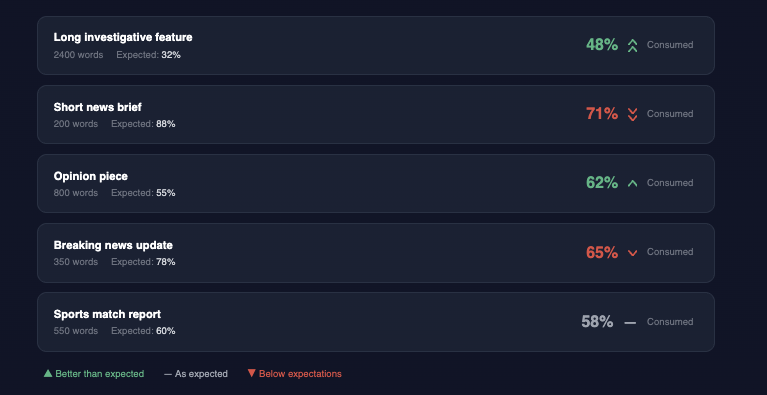
Consumed answers the question view time and scroll depth never quite settle: did the reader actually read the article? It combines time spent relative to article length with scroll depth, and gives you one clear yes-or-no number per read.
Because the measure is calibrated to article length, a short news brief and a long feature can be compared fairly. The difference between actual and expected consumption, Diff Consumed, shows which stories genuinely engage readers beyond what you would expect from their length.
For publishers working to build direct engagement with their readers, Consumed is the KPI that points the way. It rewards journalism that holds attention, not traffic that passes by, and it gives editorial teams a fair measure to optimize against.
Consumed can be activated by contacting support.
 Read more about Consumed
OAuth support
Kilkaya now supports OAuth, so applications can use OAuth to get access to API calls. A separate API key is no longer needed, and all API calls are run as the user who approved the OAuth access.
This is useful because access becomes tied to a person instead of a shared key. There is no long-lived key to store, copy or leak, and each application only gets the access of the user who approved it. If that approval is withdrawn, the application loses access immediately.
It also makes permissions easier to manage. Every API call is traceable to the user behind it, so integrations, dashboards and internal tools can connect to Kilkaya securely on behalf of individual team members without one shared credential for everyone.
Search and filter KPIs
It is now easier to find the KPI you want to pick. Search and filter the list of KPIs instead of scrolling through all of them.
Type what you are looking for, narrow the list down, and select the KPI you need in a few keystrokes.
Keep your content metadata up to date using the Kilkaya Metadata API
With the Kilkaya Metadata API, publishers can push article metadata directly from their CMS to Kilkaya in real time.
Metadata such as section, tags, authors, paywall status, and custom fields are updated independently of pageviews, providing more accurate analytics, improved personalization, and faster access to fresh content across the platform.
Simplify user administration with the Kilkaya Users API
Automatically provision and manage users, roles, and permissions directly from your organization's identity management system.
Together with SSO and multi-factor authentication (MFA) through Microsoft or Google, the Users API provides secure authentication, centralized user management, and effortless onboarding and offboarding.