Finansavisen × Kilkaya / Front Studio case study
Norway’s strongest
subscriber growth.
Finansavisen replaced a manually curated homepage, identical for every reader, with automated and personalized homepage experiences from Front Studio. This is what happened to subscriptions, engagement and churn.
#1 in Norway
Subscriber growth in 2025
+29%
Digital subscribers in 2025
-16%
Lower churn in 2025
The starting point
One homepage, every reader, all of it manual
Finansavisen is Norway’s business newspaper. Part of Hegnar Media and founded in 1992, it has around 150 employees and grew from 16,000 digital subscribers in 2019 to 31,000 in 2025.
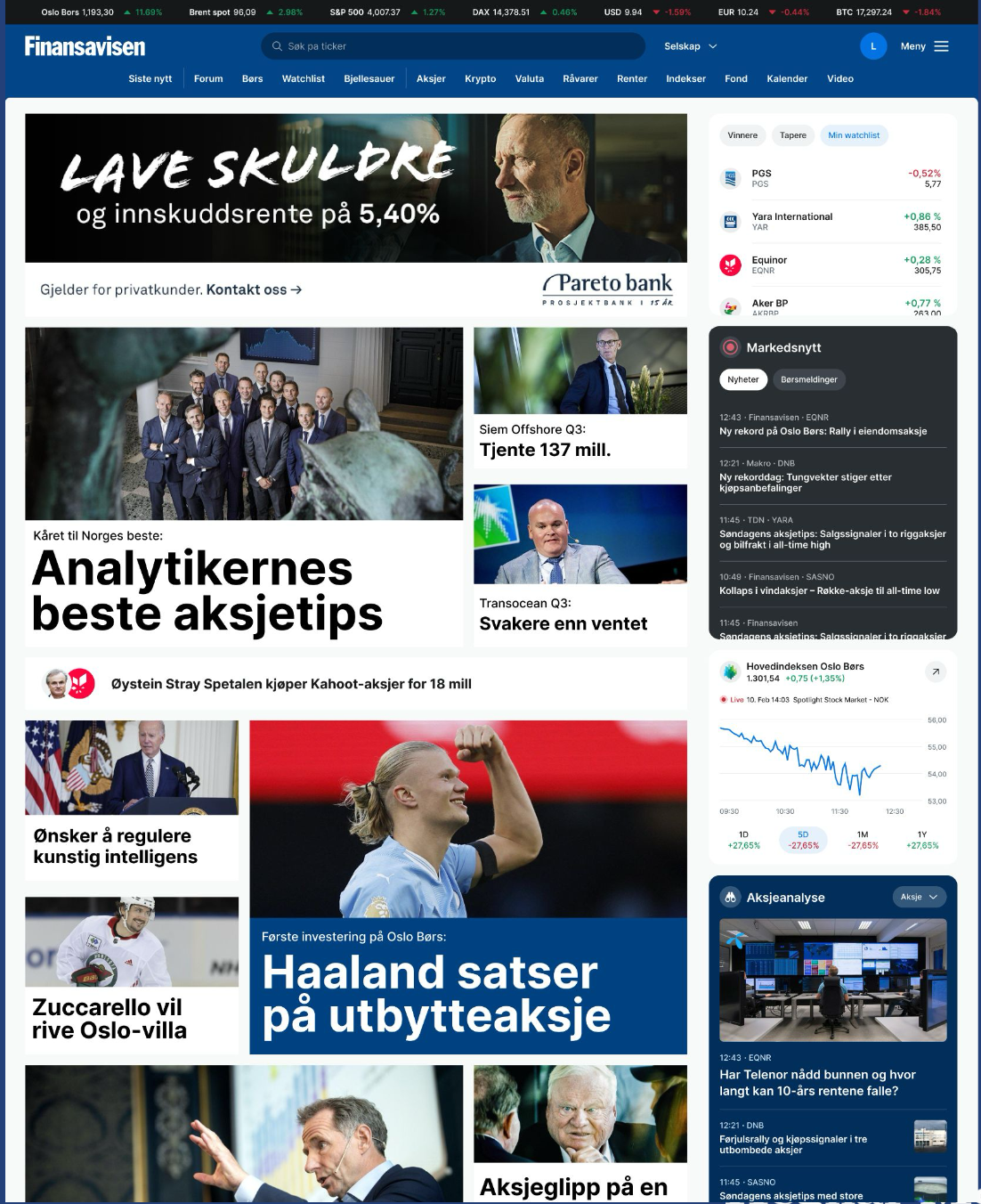
Until this project, the homepage was desked manually and looked the same for every reader. It leaned heavily toward subscription articles, which made the page less useful for readers without a subscription. Manual curation also slowed updates and limited how quickly the newsroom could test changes. Engagement among non-subscribers sat below target, and subscriber churn needed attention.
Niches within a niche
The insight that started the project came from Finansavisen itself: even within a niche finance brand, readers have fundamentally different interests, reading habits and levels of loyalty. A single homepage cannot serve them all. If the homepage could be automated, subscribers and non-subscribers could be treated differently, and personalization could be built on top of that.
Attention concentrates at the top
Years of homepage data across Kilkaya’s customers point in the same direction: most clicks happen in the first rows of the page. Personalizing further down barely moves overall click-through. That made the top of the homepage the decisive ground, and no news publisher had personalized that far up.
Distribution of clicks across homepage rows
Share of homepage clicks per row, across years of homepage data
In the kickoff meeting, the questions were about control, workflow and safeguards. COO Jon Trygve backed the project, and a cautious editorial team agreed to proceed with clear guardrails. The plan was to build Front Studio around Finansavisen’s own workflow, launch lower on the page, and expand in phases.
The solution
Front Studio: streams, layouts and personalization
Front Studio was built in collaboration with Finansavisen, around the newsroom’s own workflow. Three capabilities went live in sequence.
Streams. Automated content flows decide which articles are shown, where and to whom. Finansavisen runs one stream per reader group, subscribers and non-subscribers, each ranked by editorial KPIs and updated automatically as performance changes. The streams replaced the static homepage with audience-specific content flows.
Dynamic layouts. Editors define a set of approved templates that are used flexibly across reader groups and visits. Layout work moved from daily desk duty to configuration, and testing layouts no longer requires a CMS project.
Personalization. Once automation had proven itself, personalization was enabled in a controlled way from the top of the homepage. When a reader finishes an article, the next article from the stream takes its place, and read articles move further down. The top of the homepage stays new and relevant for each reader group. Every rule and score can be inspected, so the newsroom keeps full control.
Two homepages, two goals. Subscribers see more paid journalism to keep them engaged. Non-subscribers see the paid articles that convert best, kept on the homepage longer, alongside a healthy mix of free articles.
The rollout
From the bottom of the page to the full homepage
Finansavisen and Kilkaya launched in April 2025 and expanded in deliberate phases. Each phase was earned by the results of the one before it.
March 2025
AutomationContent streams
Front Studio was configured around the editorial workflow. The team defined content streams: automated flows that decide which articles are shown, where and to whom, ranked by editorial rules and KPIs. This phase was automation only.
April 2025
AutomationLaunch below the fold
Front Studio went live on the lower part of the homepage. Starting low and moving up let editors get familiar with the tool while the positions most readers see stayed untouched.
April to June
AutomationThe first results
Click-through on the whole homepage began to grow as the automated, prioritized stream took effect. The results gave the newsroom the confidence to move higher.
June to August
Automation + controlsEditorial overrides
Three override levels let editors take command whenever human judgment mattered more than the scores. Full manual control stayed available at all times.
August to October
Automation + personalizationNear the top
One row short of full coverage, editors gained A/B testing of headlines and images. Personalization was switched on: finished articles were replaced by the next from the stream, and read articles moved down.
October to December
Full homepageThe whole homepage, segmented
Front Studio covered the entire homepage. Subscribers and non-subscribers received two different experiences with separate goals, and subscription growth continued through the period.
Inside the newsroom
Editors can override everything
Homepage content is ranked by editorial rules and stream scores. When human judgment matters more than automation, editors can override it. If the King of Norway were to pass away, one setting would put the story at the top of the homepage for everyone, regardless of scores or personalization.
Red
Pinned to a position, where it remains. Readers who have opened the article still see it.
Yellow
Kept in the top five of the homepage for everyone.
Green
High priority for new readers only.
Editors can also test headlines and images directly on the homepage. Readers see different versions, and the results decide which one stays.
A changed role for the homepage editor
Marianne Løland Skarsgård is responsible for which stories the homepage highlights and how they are presented. Before, she manually desked one homepage for all readers, and much of her time went into layout work and maintaining a fixed structure. Now she defines priorities, rules and layouts, and the system adapts the homepage to each reader group while she keeps editorial control. Less time goes to routine placement, and more to the journalism that needs it.
The results
What changed in 2025
In 2025, Finansavisen grew its digital subscribers by 29%, the strongest subscriber growth among Norwegian news publishers. Subscriber pageview volume rose 19% between March 2024 and December 2025. Churn fell 16% over the same period, while sales grew rapidly.
The strongest subscriber growth in Norway
Subscriber CTR remained stable under the same logic
March 2024 to December 2025
Churn fell while sales grew rapidly
The homepage for non-subscribers offered a more relevant mix of free and paid articles, and engagement followed. The paid articles that convert best stay on the homepage longer for this group, which raised the likelihood that readers subscribe.
The churn development is notable. Higher sales normally push churn up, because newer subscribers cancel at higher rates. Churn fell 16% during the strongest sales period in the newspaper’s recent history, which the project links to paid content being surfaced more prominently to subscribers.
Finansavisen is among the first news publishers in the world to move from a single, static homepage to multiple personalized homepages based on reader groups. The result the team values most sits behind all of these numbers: the editorial team changed how it works, and the transformation was built on its trust.
In her own words
Watch the Full Presentation
Margrethe Schmidt Hegnar, COO at Finansavisen, presents how Finansavisen and Kilkaya moved the homepage from manual curation to segmentation and personalization with Front Studio, and what it has meant for subscriptions, churn and the newsroom.